
Nice Not Direct Look

About Leonora

Leonora Meriel is a British novelist and author of four literary fiction novels.

Born in London, Leonora (or Leo, to many friends) went to school in London and the Leys School, Cambridge.

She studied English Literature at the University of Edinburgh and Queen’s University, Canada, before moving to New York to work at UNESCO at the United Nations and then the marketing department of a major law firm.

In 2003, she moved to Kyiv, Ukraine, where she co-founded Ukraine’s largest bookshop, Yakaboo, and spent a year as President of the International Women’s Club of Kyiv. While in Kyiv, she did an MBA at Kyiv Mohyla Business School, a part of Kyiv Mohyla Academy – the oldest university in Ukraine. As part of the MBA course, she climbed, and camped on, Ukraine’s highest mountain in the Carpathian Range – Hoverla.

During ten years in Ukraine, Leonora was witness to two revolutions: the Orange Revolution of 2004 and the Maidan Revolution of 2014.

Leonora’s first novel, The Woman Behind the Waterfall, was published in 2016 and was called “strange and beautiful,” by writer Esther Freud, “an intoxicating world” by Kirkus Reviews and “a literary work of art” by Richmond Magazine.

The Woman Behind the Waterfall is set in western Ukraine and tells the story of three generations of women seeking happiness against a background of Ukrainian language and culture.

In 2017, Leonora released The Unity Game, a philosophical, literary and Science Fiction novel, which Kirkus Reviews called “ambitious and thought-provoking.”

In 2022, she published And Breathe, the story of three people seeking peace and recovery at a silent meditation retreat in the Thai jungle. As research for the book, she spent 11 days on a Vipassana meditation centre – finding it a transformative experience.

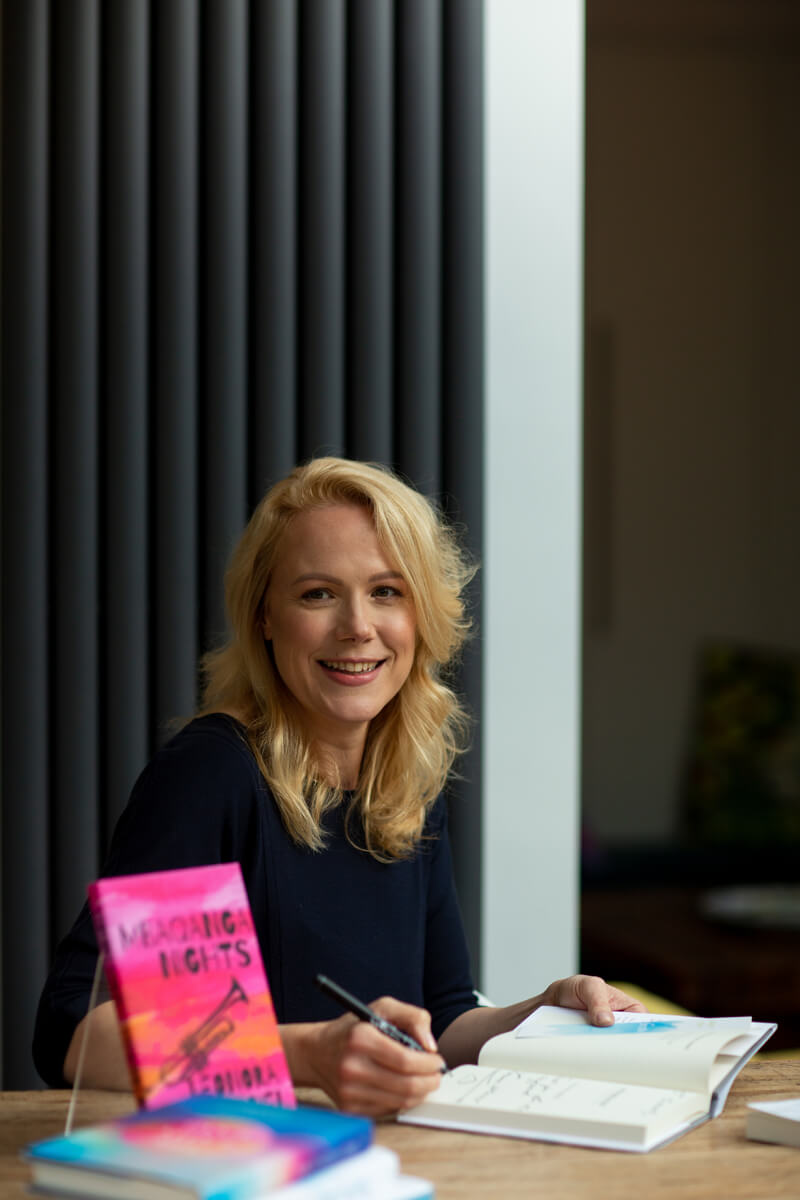
Leonora’s latest novel, Mbaqanga Nights, tells parallel stories of young music lovers opening a jazz club in Durban, South Africa during the final years of apartheid; and the great-grandfather of the protagonist choosing to leave his shtetl in 1890s Ukraine to emigrate to Cape Town, while his brother sails for New York.

At the heart of Mbaqanga Nights is the question of impossible choices and the decisions people make in their lives which impact them and generations of their families for years to come.

Her research for the book included extensive reading, and trips to South Africa, to Hamburg in Germany and around London’s East End as well as interviews with important cultural figures.

In 2023, following from the invasion of Ukraine, Leonora helped to found and became Chair of Trustees of Restart Foundation, a charity with the vision of bringing great mental health to Ukraine. The charity runs psychology programmes in kindergartens and schools, to protect young children from the trauma of bombings and surrounding war.

Leonora currently lives between London and Barcelona and has three extraordinary children and a black cat called Ellie.

Watch Leonora read Chapter One of The Woman Behind the Waterfall

Recorded at Novel London, Waterstones Covent Garden, November 2016

Q&A With Leonora

My earliest memories of my life are telling people that I want to be a writer, and all through my childhood I had a reverence for books and a sense that there could be nothing more wonderful than being the creator of such marvelous, miraculous things. As I went from reading to writing, the reverence only grew deeper as I understood more clearly the skill and brilliance that went into those extraordinary works. Books and writing are the greatest passion of my life.

The different ideas come from my fascination with everything – life on planet Earth, life beyond planet Earth, the worlds of the subconscious and the imagination, the worlds we create from writing words on a page, the power of creation. I have a hunger for experiencing and understanding and exploring all the aspects of human existence that can be accessed, and this then presents ideas for stories which don’t fit into similar patterns. I’m not interested in writing similar books, I’m interested in exploring the topics that I don’t myself understand and look to reveal through their portrayal in words.

My books often start with a powerful scene that plays in my head over and again, which has a particular emotional element to it. I then write the scene, and from then I understand which themes I need to build from that and which characters can help me express it.

Most of the books I read move me in some way. I can be moved by the power of the story or by the impact of the book or the language itself; even by the editing. I find books that are still relevant after hundreds of years enormously moving, reminding us of the parts of humanity that remain constant.

The last book that had a big impact on me was Ursula Le Guin’s The Word for World is Forest. It’s a novella, written so perfectly and with such aggressive and relevant themes, that you want everyone in the world to read it. Le Guin starts off with a brilliant plot, and layers in giant topics of colonialism, race, sex, base versus higher nature of humankind, political ideology, political realism and human idealism – there is always hope, even in her darker tales. She is Shakespearean in her grand themes and understanding of humanity; and she is academic in the precision of her writing.

Her skill leaves me amazed and moves me profoundly.

I have an approach to reading a book which is that if the book has not changed me in some way through the reading of it, then it was not worth my time. When I dedicate several precious hours of my life to something, I want it to have brought me something wonderful. This can be an element of personal growth or transformation; a new understanding of the world; new information on the world or a relevant topic; new insights into humankind; or new ways of writing. Any book that changes me in some way, I find inspiring.

This means that I read widely – both fiction and non-fiction, and I try to push my reading and look for unexpected books. I try to read from different countries and cultures and a combination of old and new. Inspiring books can be found in any genre, but perhaps the most exciting use of language is often in literary fiction, so I read more of this than others. Science fiction is often where the boldest ideas are found; and poetry is where there can be dazzling combinations of emotions and perspectives.

A few writers who dazzle me are Haruki Murakami, Ursula Le Guin, T. S. Eliot, Michael Cunningham, Jane Austen, Octavia Butler and Nadine Gordimer.

This process is entirely natural and comes with writing the first draft of the book. I start with an idea that won’t disappear – it could be something that has been circling my mind for months or even years. I start by writing around this idea, and then a first draft of a novel comes very quickly and easily. The writing part is easy because it’s allowing the mind the freedom to explore something that it’s hungry to explore. I put no limits on the first draft.

When I come back to the novel for shaping and editing, then I’m already hungry for the novel to take its full form and be ready for the world, so there’s a total immersion there, whether it’s in additional research, sentence crafting or structural editing.

Writing is my greatest passion, so an immersion in the creation of a book is pure happiness to me.

I tell the story of where the book came from in the book itself, as I put myself – “the writer” – as a character in it.

It started at a Christmas party when a new friend started telling me about opening a jazz bar in South Africa during apartheid. Something about this story immediately electrified me as I could sense the tension in every part of it – and the excitement and importance of it. Once I started researching the topic, I found it was true – the story was poised at the center of about a hundred other incredible stories, all leading off from this time/space event of opening a jazz bar in Durban, in the 1980s.

When my friend then shared with me that his great-grandfather had emigrated to South Africa from Ukraine, then I knew the story was for me. I have an enormous interest in Ukraine and this was an opportunity to research and write about a side of it which I wasn’t familiar with – the 1800s and the life and culture of Jewish people in the Ukrainian territories.

The challenge was writing a story that was part historical fiction, part biography, where many of the characters were both still alive and also important cultural figures in the history of South Africa. It was quite a terrifying process but I took each draft and each step as carefully as possible, involving as many people as I could in it. What I found was that the people in the book were keen to have the story written – they understood what an important narrative it was and the historical significance.

The main research for the book was reading. Once I’d understood that I was going to write the book, then I started reading around it, and I spent an entire year immersed in books. I started with the history of South Africa, and then South African jazz, and then Jewish history in Ukraine and emigration at the end of the Nineteenth Century. Once the history was covered, I then read as much of the literature of South Africa as I could; and of Jewish Ukraine and of emigration and of jazz. I read some of the greatest books I’d ever come across.

At the same time came physical research – a visit to South Africa to talk to people who featured in the book and who had been there at the time of the events; and to see the places and the people and the land. A visit to Hamburg to the emigration museum which tells the story of the millions of people who left the German port travelling to America or Africa or South America. These people had come from all over Eastern Europe, as well as Germany, and had taken perilous journeys to reach the port. Closer to home, visits to London’s East End, where many of the immigrants had lived, either waiting for boats onwards to other continents, or settled in the city.

The final part of the research was checking the story with the people who are real characters in it, and adding details from their recollections.

I first visited Ukraine when I was 22, and then moved there when I was 25. Ukraine was a fascinating and extraordinary country, so clearly in a period of intense transformation from a way of life that no longer existed, to a future that it couldn’t yet imagine. To live in a country while that change is happening is one of the most thrilling experiences. From day to day, you can see history altering a nation’s mindset, actions, choices, perspectives and futures. A year after I arrived the Orange Revolution took place, and then later the Maidan Revolution. In between that was a turmoil of politics and protest and hope and opportunity and the younger generations growing up and envisioning bright futures as Europeans.

I lived in Ukraine for ten years, during which I co-founded and ran Ukraine’s largest bookshop, and was President of the International Women’s Club of Kyiv – a major charity. It’s a country that has an important place in my heart.

I came to self-publishing by chance, when my debut novel received a lot of praise from publishers and an agent, but didn’t find a home.

I’d heard of self-publishing and did some research and found – to my delight – that it was possible to create and distribute a published book with exactly the same quality, processes and distribution network as an established publishing company.

I was already a successful entrepreneur after founding and running Ukraine’s largest on-line bookstore, and I had an MBA and a wide range of business skills, so self-publishing suited me perfectly.

Essentially, with self-publishing, you are a small publishing company, with yourself as the client. This means you’re in charge of production, quality, distribution, marketing, sales and finance.

For me, this works brilliantly, as I have full control over the timing, production and distribution of my books.

Perhaps the most powerful thing about self-publishing, however, is the creative control you have. When you sell your rights to an external publishing company, they can choose to sell your work in any package they like, through the cover, blurb, press-angles, genres and more. They can even decide to stop distributing your work, if they’re not happy with the sales performance.

With self-publishing, you can exercise the full creative expression of the story you have crafted, from the cover, to the book description, to marketing channels, to choice of reviewers, to genre-placement. To me, this is a far more authentic and satisfying creative journey than just writing the book and then handing it off to someone else. It means full creative control and expression which is something I absolutely love.

I’m full of ideas and my great hope is that my novels get faster to write. I have two children’s books that I plan to launch in 2025 and 2026, and then several novels which are waiting for a first draft to be written. I can feel several big themes circling in my head and gathering momentum so I’m hoping to clear some months later in 2025 to write some first drafts.

I’m also – very excitingly – helping some other people to self-publish their works. I’m working with my father on a ground-breaking book on Franz Schubert that will come out in 2025, and also with a friend on a London guidebook and children’s book, and another friend with a fantasy debut. It’s one of my great passions to inspire other people to get their stories out into the world.

So, in short, a delightful combination of writing and publishing my own and other’s works.