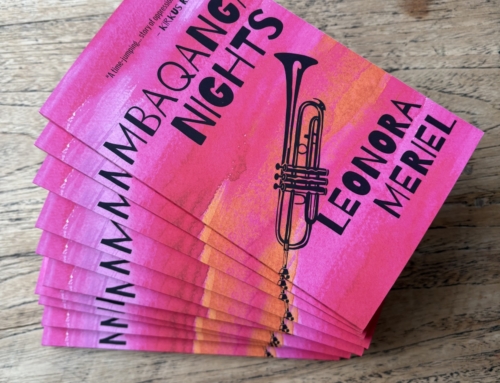
The making of the book: Mbaqanga Nights
On February 1st, I launched my fourth novel, Mbaqanga Nights, to wend its way to readers worldwide.
It was a long time in the making – over five years from the day when I heard a new friend say something so interesting that I couldn’t let it go.
“I opened a jazz club in South Africa during apartheid,” he told me.
And I was hooked.
The excitement and tension implicit in this story made me want to hear more, and when he shared with me that his great-grandfather had emigrated to South Africa from Ukraine, I knew that this was a story I had to write.
As usual, the first draft of the book was written quickly – this is always the most pleasurable part of being a writer, when you can put down a story in an uninhibited way, with all the ideas you have flowing into one place.
And then came the research.
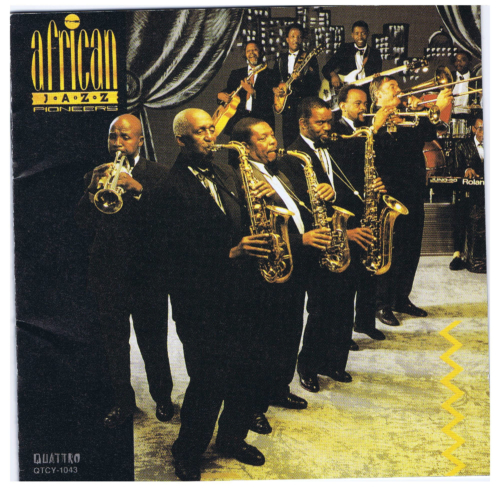
The kings of mbaqanga: The African Jazz Pioneers, on the album produced by my friend, on whom the book protagonist is based
My friend, on whom the protagonist of the book is based, was incredibly patient with me as we drank wine and he shared so many details of the jazz club and how it came to be. Every detail was fascinating, and there was so much more than could fit in the book.
One word kept coming up repeatedly: mbaqanga. It seemed to be central to everything he was saying, and it was also such a great word. He explained it to me as a style of South African jazz. In fact, it’s a style that has evolved in South Africa from many different influences: marabi, American blues, Harlem jazz, kwela and swing among others, and it was what was playing in the jazz clubs of Durban and Johannesburg in the 1980s, when this story is set. It felt like it captured the uniqueness of South Africa together with the many influences that make it what it is today. And the word itself, hopping, rhythmic, unlike-anything else, made me feel it captured what South African jazz is and was. Mbaqanga. I had a title.
The research beyond drinking wine with my friend had 3 stages.
The first was reading. I read everything I could about South African history, Ukrainian history, Ukrainian emigration and South African jazz. Then I read as much of the literature that I could: South African literature, Ukrainian literature, Ukrainian emigration literature, Jewish literature. I read some of the greatest books I’d ever encountered – I’ve put some of my favourites into a list here.

Some of my reading on South African history, literature and jazz
The second stage was the physical research. A trip around South Africa to see the places in the book and meet the people who had been part of the story. A trip to Hamburg to the Emigration Museum to see where millions of people had sailed to new lives on different continents. Walking around East London to see where the emigrants had lived and worked.
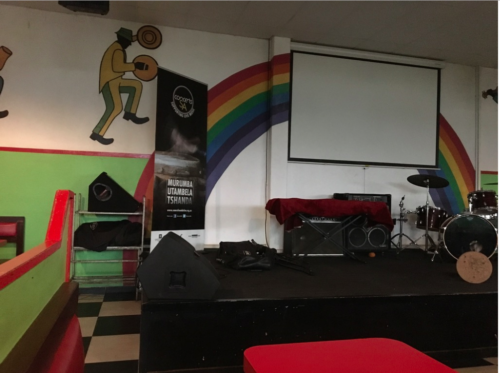
The Rainbow Restaurant in Durban, South Africa in 2018
And the third stage – talking to the people whose real lives were in the book, and showing them the draft I had written and asking them to check it. This was by far the most terrifying part of the process, as any of the real life people in the book could have told me that I’d got everything wrong, that it wasn’t my story to tell, or that I couldn’t possibly know how it had felt at the time.
But the reaction I got was the opposite. Encouragement, kindness, and a great sense that people were happy for the story to be told, that I had captured how it really felt at the time – that it was an important story and time for it to come out into the world.
As Darius Brubeck, who played the piano almost every week in my friend’s Durban jazz bar, wrote:
“I was a ‘house pianist’ at Coltrane’s for as long as it lasted and Meriel’s snapshots of those tense days and Mbaqanga (South African music style) nights ring true.
Her kaleidoscopic composition shakes together the frozen darkness of Eastern Europe, the blinding glare of Durban, the dread of pogroms and township faction fights, the exultation of jazz and the trials and triumphs of a few hard living and brave young South African whites who made a go of an impossible business.”
And the wider reaction?
Kirkus Reviews reported that “Meriel displays… commanding knowledge of Ukrainian and South African history.”
And Philippe Sands, one of the authors who inspired the book with his amazing “East West Street” called it, “A wholly original take on matters of history, identity and life, one that is timely, engaging and finely crafted.”
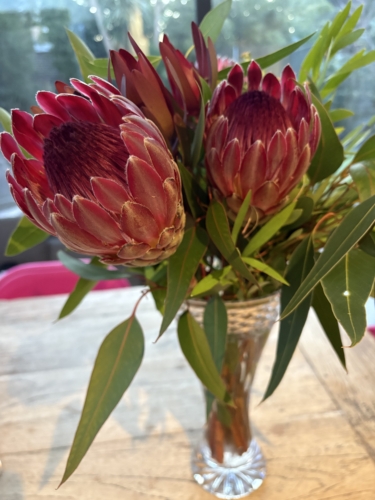
Beautiful Cape Town protea given to me in celebration by my lovely husband Dan, to whom the book is dedicated